
Written by Nathalie
Edited on
25 August 2025
·
07:18
5 tips for drilling in concrete
Drilling into concrete is a demanding job. If you do it wrong, the drill will break or your wall will get damaged. In this article, we'll give you 5 tips on how to succesfully drill in concrete. For example, you'll need a drill with a hammer function and a concrete drill bit. You can also prevent damage and dirt with a depth stop, wall scanner, and construction vacuum.

Get started with drilling in concrete
Drilling in concrete isn't difficult, but requires some attention. Follow these tips:
Tip 1: choose the right drill bit.
Tip 2: use the hammer function.
Tip 3: work with a depth stop.
Tip 4: pay attention to pipes.
Tip 5: vacuum drill dust directly.

Tip 1: choose the right drill bit
There are dill bits for various materials. For concrete, you use a concrete drill bit. You can recognize this drill bit by its blunt tip with wings. While a concrete drill bit looks like a stone drill bit, the tip is made of a stronger metal. That way, the drill bit can withstand lots of force. A concrete drill bit usually has an SDS connection. With this, you can firmly attach the drill bit to the drill chuck and it won't slide away while you're drilling.

Tip 2: use the hammer function
If you want to drill into super hard materials, you need the hammer function of your drill or combi hammer. Thanks to this function, the drill moves forwards and backwards. Without this hammering movement, you can't get through concrete. Check whether the button for the hammer function is on before you start drilling.

Tip 3: work with a depth stop
When you drill a hole in concrete and use a plug or anchor, its important that the hole has the right depth. The plug won't fit in a hole that's too shallow. Is the hole too deep? The plug will disappear. With a depth stop, you prevent this. Place the plug against the drill chuck and adjust the depth stop to the tip of the plug. That way, the hole is exactly deep enough.
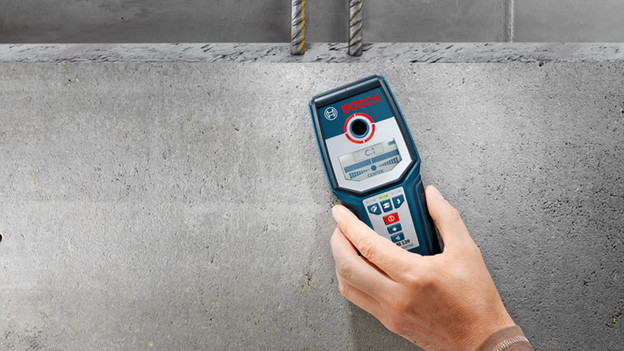
Tip 4: pay attention to pipes
You don't want to hit any water or electricity lines when you drill in concrete. Otherwise, you'll cause damage and might have to break open the wall. That's something you don't want when you're just mounting a plank. With a wall scanner, you can check whether there's pipes or concrete reinforcement in the wall. That way, you'll know you can safely drill a hole.

Tip 5: vacuum drill dust directly
For a neat drill hole, you have to pull back the drill a few times at a low speed. This way, you can dust and grit out of the hole. Use a drill dust collector or let someone vacuum the dust with a construction vacuum. That way, you can keep your workplace clean.
Article by Nathalie
Drill Expert.

