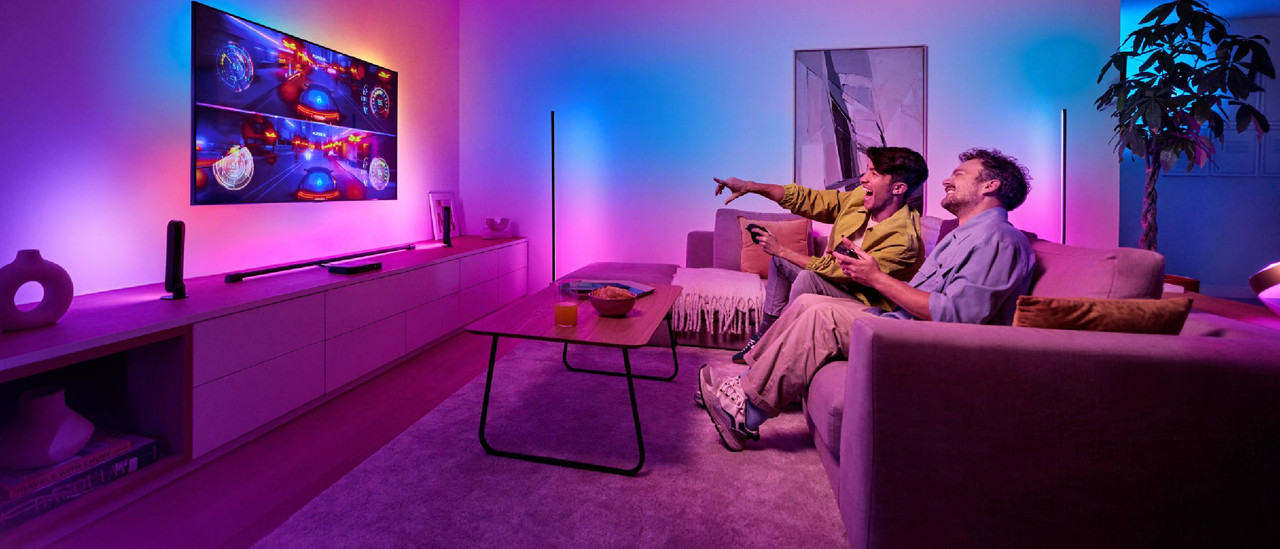
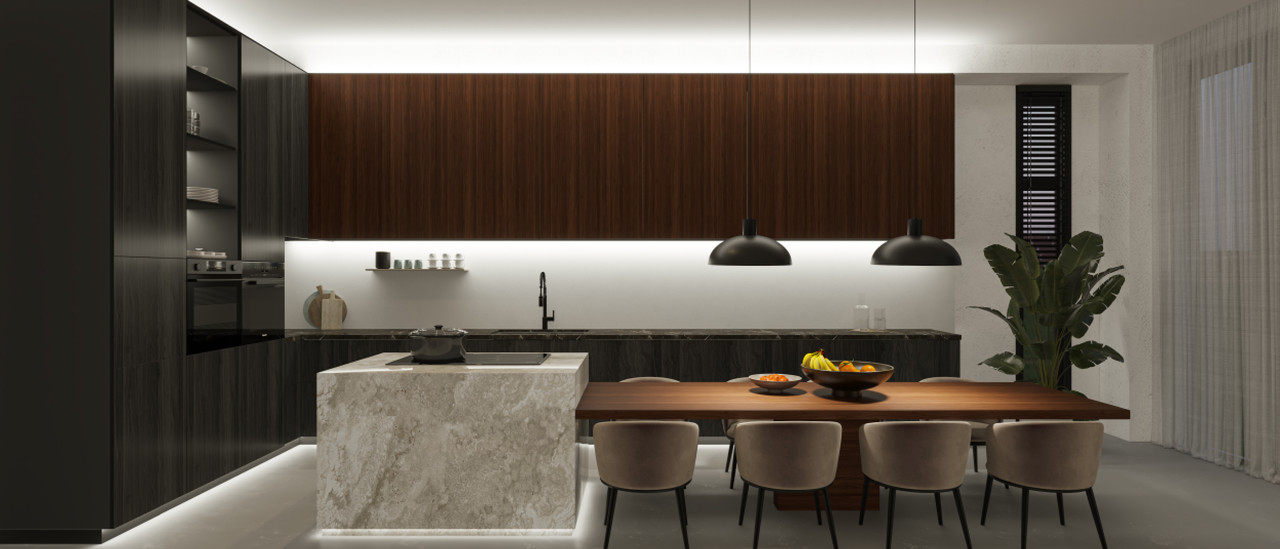
Beautiful LED strip, good color rendering, high light output with Warm White and White and probably ideal for the simplest configurations.
But all in all, it is a lot of money for what it is and Philips is missing a lot of potential.
The Hue gradient LED strip exposed:
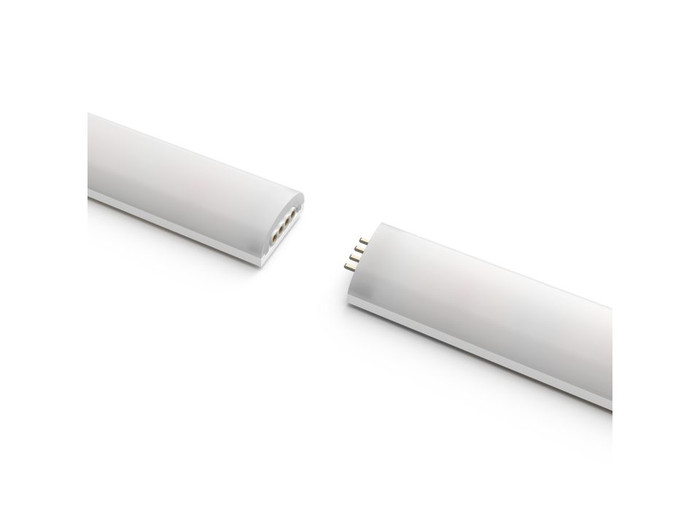
Simply put, this is a W+WW+RGB LED strip with 7 ICs per meter and 6 LED clusters (1 cluster = W+WW+RGB) per chip (so 7x 6 = 42 LED clusters per meter) connected to a Zigbee node in a small box where the power supply is also connected.
Cut to size:
In principle you can cut to size per IC (chip) and therefore per 6 LED clusters (12.5 cm). However, Philips only puts markings on the silicone strip per two ICs (25 cm)... sorry for the ink for the arrows. the silicone strip can't cost that much. This is also confirmed by the scissor marks on the bare, exposed strip. (and yes it works too)
That brings us to the next point:
Direct lighting application:
The individual LEDs are still clearly visible (in direct lighting applications). The LEDs are not close enough together and the silicone diffuser is too close to the LEDs, which means that the light cannot spread sufficiently. The only option is to provide a higher LED profile yourself, but then you have to get rid of that silicone sheath (heat dissipation). Removing the sheath requires caution and patience and of course you lose the warranty!!. Using a utility knife with a jaw blade and always cutting at the back of the strip without hitting LEDs, resistors or ICs, this worked out well in the end... why doesn't Philips simply provide a version without a silicone sheath?
Connectors:
Connection options to connect different pieces around corners are non-existent at Philips, the supplied coupling piece to make corners is simply too thick for neat applications. Ultimately had to order Y-splitters and connectors of different lengths from Litcessory.
Tip:
Test your LED strips + extensions on ALL colors (not just white or warm white) before you stick them, in my case there was 1 chip that controlled the RGB values over 12.5 cm differently than the other ICs, resulting in a strong color difference over that length.
Software:
The gradient options could be further developed so that the user can also create his own more complex gradients, given the 6 LEDs per chip, a gradient effect will always cover at least 12.5 cm, in contrast to the Dreamcolor LED strip series that have an IC per LED and can even have more than 100 LEDs per meter.
Looking back on this project with Hue Gradiant LED strips:
For simple, straight, cupboard or staircase or wall projects, I would recommend the gradient LED strip if the price were not a bit too steep for me.
For more complex LED strip installations, I would not recommend this, given the effort you have to put in to achieve a clean result. A number of Dreamcolor LED strips + ESP32 + power supply would have cost me a lot less and given me more options with just as much or less effort, if it weren't for the fact that the LED strips can now be configured/operated in the same Hue app as all other Hue lighting... .