Written by Caitlin
Edited on
27 January 2025
·
13:10
How do you keep your oven from causing a short circuit?
You turn on your oven, and it short-circuits right away. In most cases, that's because you've connected too many appliances to the electric circuit. In this article, we'll tell you how you can check if this is the case and how you can fix it.

Prevent short circuits
Does your oven turn off suddenly? That's often due to peak load. Your oven peaks in terms of energy when you turn it on. If there are too many appliances connected to the 1 electric circuit, or the minimum power supply of your oven is too high, the fuse will blow. In that case, too many devices are connected to 1 electric circuit. It's not strong enough for that. We'll tell you what you can do about that in this article.
- Tip 1: check your electric circuit
- Tip 2: connect your oven to a socket outside your kitchen

Tip 1: check your electric circuit
Every appliance has a minimum power supply. This value is noted in the manual, and it denotes how much power the appliance uses at most. If you add all these values of all appliance in a electric circuit, you know the required connection capacity. This can't be higher than the power of the electric circuit. As a rule of thumb, keep in mind that a circuit can handle a maximum of 3500W power at once.
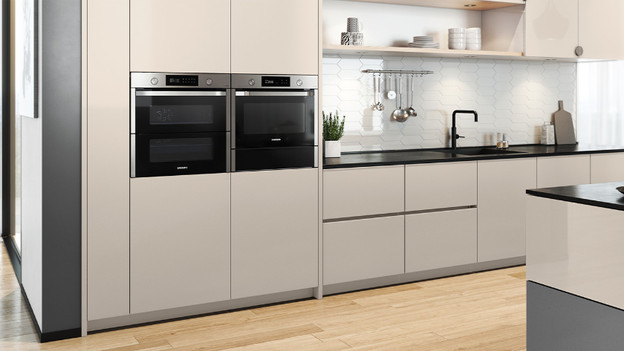
Tip 2: connect your oven outside your kitchen
Connect the oven to a socket outside your kitchen. Does it work now? You now know the problem lies with the electric circuit in the kitchen. Connect some appliances to a different circuit. Do you want to use the oven in the kitchen? Let a certified electrician add an extra circuit.
Doesn't it work? The oven might be irreversibly damaged. Contact our Customer Service.